-
-
COMPETITIONS
-
ROBOTICS, CODING AND AI FOR CHILDREN AGES 7 TO 18
Exploring Artificial Intelligence Through Educational Robotics
Artificial intelligence is one of the technologies that surrounds us in everyday life. When it is discussed at school, people often mention generative AI (text, images, etc.), the types that students are most familiar with. However, AI goes far beyond these visible uses: it is integrated into many systems around us. It is essential that young people understand how it works and how it is concretely embedded in the different technologies they use. Educational robotics provides an excellent entry point for exploring these concepts in a progressive way that is well suited to students.
EXPLORE ARTIFICIAL PERCEPTION WITH MAKEBLOCK
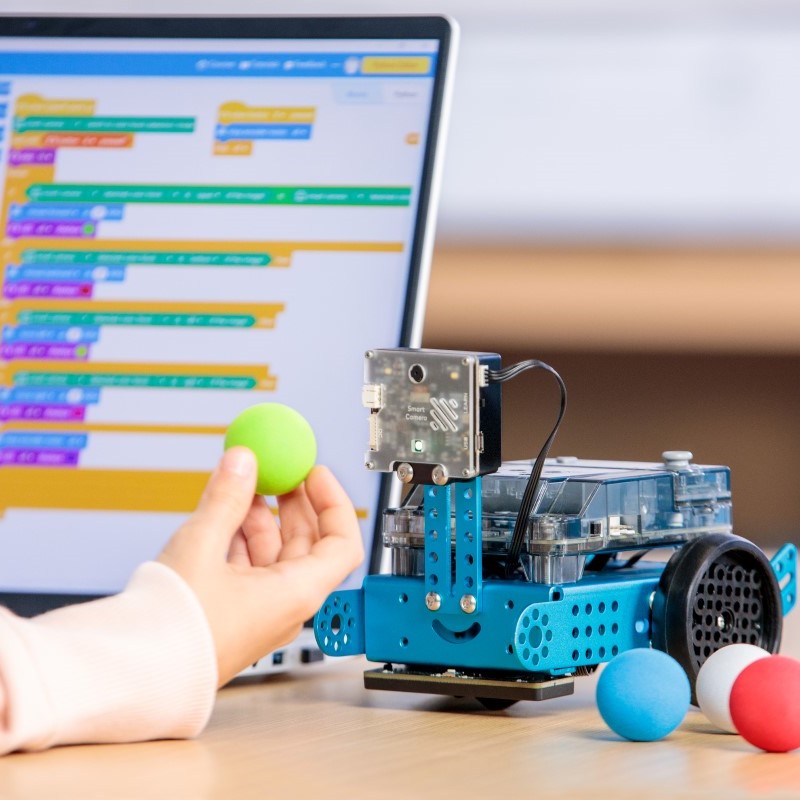
Unlike a traditional robot that simply executes instructions, a robot equipped with artificial intelligence can perceive and interpret its environment. Thanks to smart cameras such as the Makeblock AI Camera, it does more than just “see.” It can recognize faces, colors, gestures, sounds, objects, and even markers.
Students can go even further by creating their own recognition model. They learn how to train an AI to identify specific objects or situations and gain a concrete understanding of how a system can analyze an image, interpret a signal, or make an appropriate decision. In this way, they discover a fundamental concept: an AI does not “know” anything at the beginning. It learns from the data it is given.
PROGRAM AN INTELLIGENT ROBOT WITH VEX AIM
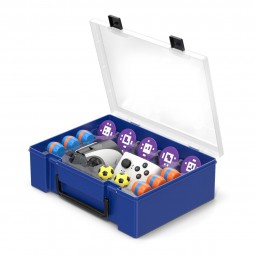
With VEX AIM, students program a robot equipped with an AI camera capable of detecting colors and AprilTags (visual markers used in robotics). They can:
- Code screen-free, with blocks, in Python, or in C++
- Program autonomous behaviors
- Manipulate objects using a kicker system
Here, artificial intelligence becomes a concrete tool used to tackle a challenge. Students must analyze a problem, program a strategy, and test their robot. It is also a great preparation for VEX robotics competitions, where computer vision and autonomy play a key role.
UNDERSTAND AI–ROBOT INTERACTION WITH MARTY
With Marty, the approach is different but just as pedagogically interesting. Here, image or voice recognition is performed by the computer. The information is then transmitted to the Marty robot, which executes an action based on the result obtained. Students therefore understand an important reality: AI is not always located within the robot itself. It can be external, running in the cloud or on a computer, and then control a physical system.
This structure makes it possible to introduce concepts such as data processing, communication between systems, and automation.
EXPLORE EMBEDDED AI WITH ARDUINO AI LAB
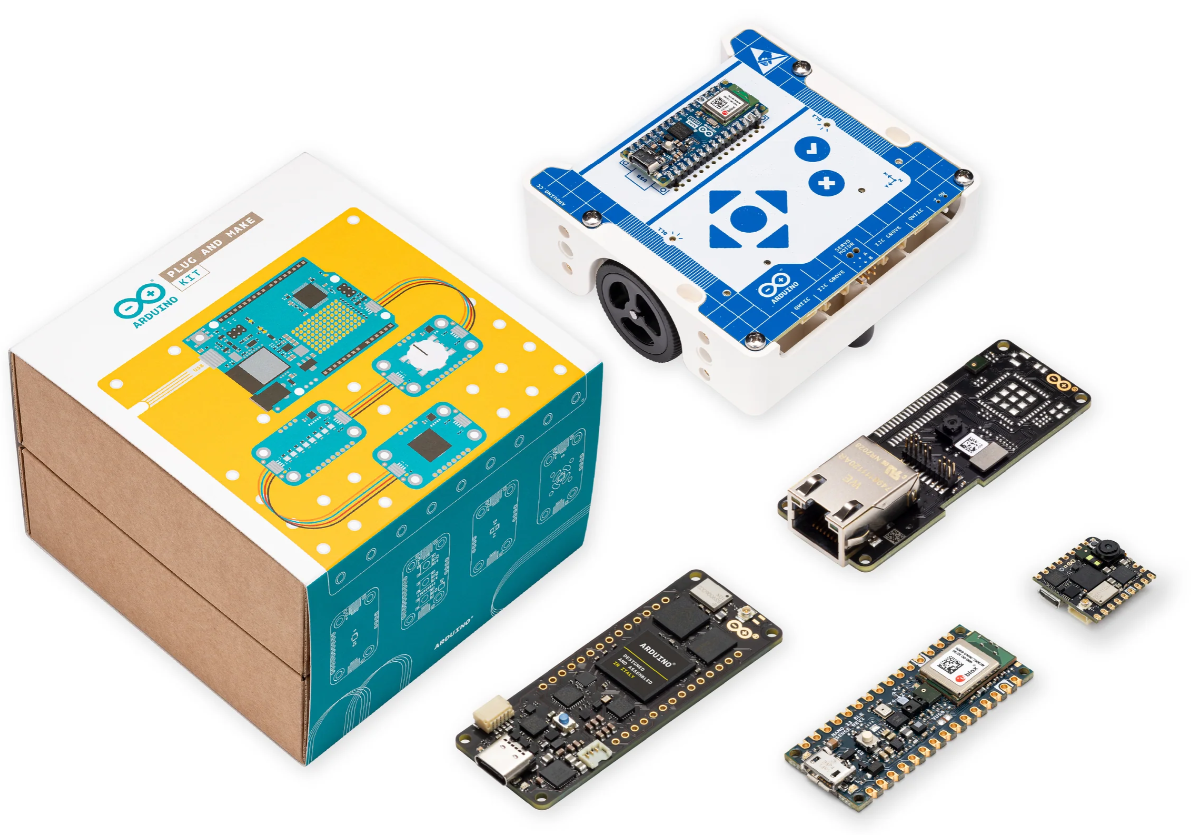
The Arduino AI Lab Kit allows students to explore artificial intelligence through the lens of embedded AI, meaning AI that is integrated directly into an electronic device. Students can train models capable of recognizing images, sounds, or movements, and then integrate them into a concrete project.
This approach is particularly interesting for understanding that artificial intelligence can run locally, directly on an electronic board. Students therefore discover the essential stages of an AI project (data collection, training, testing, improvement, etc.) while connecting these ideas with electronics and programming.
FREE TOOLS FOR EASY EXPERIMENTATION
It is also possible to explore these concepts without any specific hardware. Free tools like Google Teachable Machine allow students to quickly experiment with image, sound, or posture recognition. In just a few steps, students can train their own model using examples they provide themselves. They can then observe the results in real time, making the concept of machine learning very tangible. These platforms offer an excellent introduction to understanding how an AI model works, testing its limits, and starting a critical reflection on the reliability and use of intelligent systems.
IN CONCLUSION
Approaching artificial intelligence through educational robotics allows students to move beyond an abstract or limited view of AI. By handling, programming, and experimenting with intelligent systems, they understand how a machine perceives its environment, makes decisions, and interacts with the real world.
These approaches promote a gradual understanding of AI, tailored to the students’ level, while also developing essential skills such as algorithmic thinking, problem-solving, and logical reasoning.
Related Products
Related Posts
-
18/11/2025
Help to clean the Mangrove Reef with VEXcode VR!
Posted in: Posts03/12/2020In the Coral Reef Cleanup activity, you are equipped with a VR Ocean Cleaning Robot to help clean the Mangrove Reef.... -
19/11/2025
How Educational Robotics Connects STEM Disciplines
Posted in: Posts21/01/2021Robotics is always interdisciplinary in ways that are tangible and applicable to students. Students gain an... -
23/11/2025
Robotics? In school? What for?
Posted in: Posts16/02/2021Building a robot allows students to deepen their knowledge in math, mechanics, engineering and programming while... -
23/11/2025
Teaching Python with VEXcode VR
Posted in: Posts29/05/2021Python is arguably the most in-demand programming language for job seekers. It is also one of the most popular... -
23/11/2025
Grant Writing Guidance
Posted in: Posts07/06/2021Funding is out there, from many different sources. The application process for this funding can seem daunting,...